

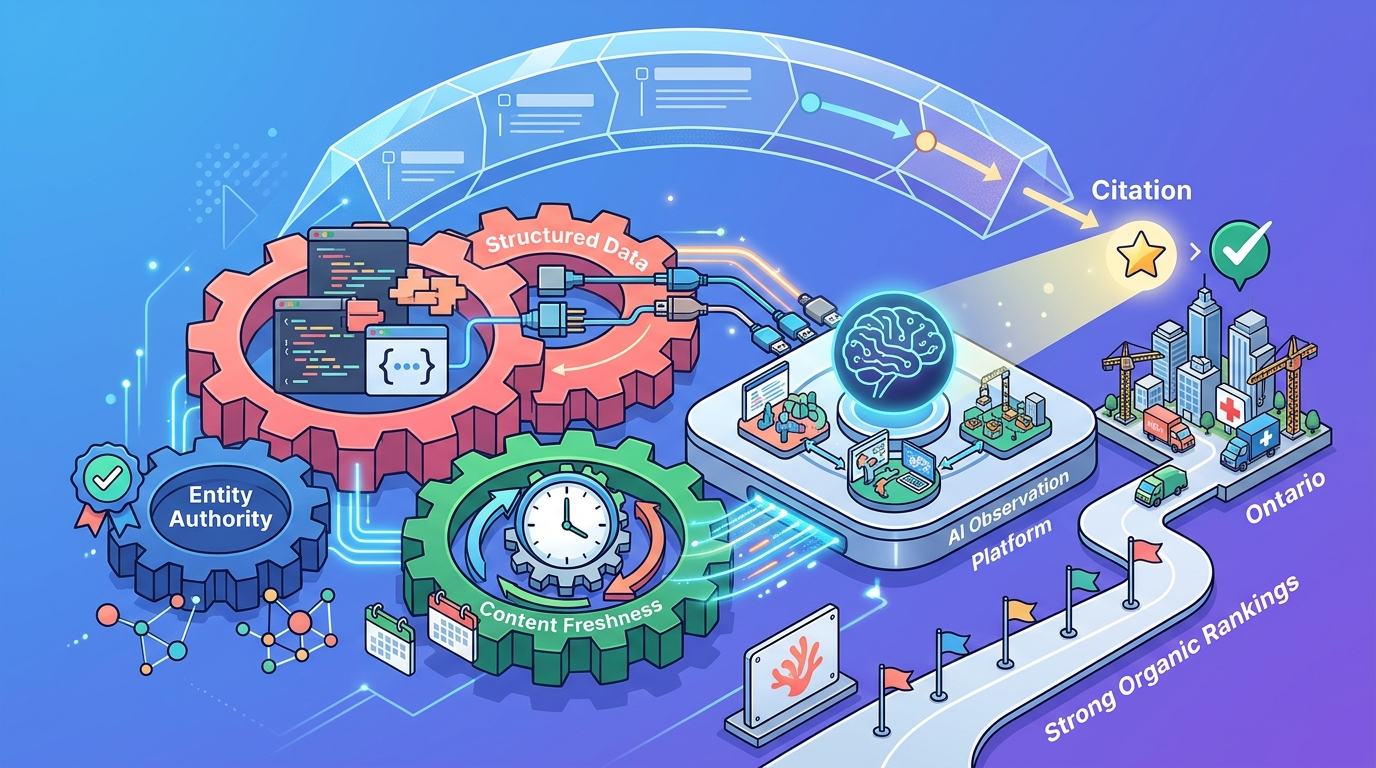
Businesses earn AI citations by combining structured data, entity authority, content freshness, and strong organic rankings. Mango Media uses these four strategies to help Ontario service businesses appear in AI-generated answers. This guide explains how each tactic works and why they must function together.
Structured Data Markup
Structured data is a standardized format that helps search engines understand the meaning of content on a webpage. It acts as a bridge between human-readable text and machine-readable data. For AI systems, this markup provides the exact facts needed to generate accurate summaries.
Schema.org Implementation
Using Schema.org vocabulary allows you to define entities clearly. You can specify business types, services, locations, and reviews. This precision reduces ambiguity for AI models that parse your site. When an AI tool encounters well-marked data, it can extract facts with higher confidence.
Local Business and Service Schemas
For local service providers, LocalBusiness and Service schemas are critical. They define your service area, operating hours, and contact information. This data helps AI tools answer questions like "who is available near me?" accurately. Mango Media integrates these schemas into every client website to ensure local visibility in AI search results.
Validation and Monitoring
Invalid markup can lead to data being ignored by search engines. You must validate your structured data using testing tools. Regular monitoring ensures that updates to your business information are reflected in the markup. This maintenance is essential for keeping AI citations current and accurate.
Entity Authority
Entity authority is the degree to which a business is recognized as a distinct, trustworthy subject across the web. AI systems rely on entity recognition to distinguish your business from competitors. Building this authority requires consistent information across multiple sources.
Consistent NAP Data
Name, Address, and Phone (NAP) consistency is the foundation of entity authority. If your details vary across directories, AI models may struggle to verify your existence. You should ensure your core business information is identical everywhere. This consistency signals reliability to both search engines and AI assistants.
Third-Party Mentions
Mentions in reputable third-party sources strengthen your entity profile. These sources can include industry publications, local news, or professional directories. AI tools analyze these external signals to gauge your credibility. A strong web of authoritative mentions helps your business stand out in AI-generated recommendations.
Knowledge Graph Optimization
Optimizing for the Knowledge Graph helps search engines map your business to related concepts. This involves creating clear connections between your services, locations, and industry. When your entity is well-mapped, AI tools can more easily retrieve relevant information about you. This mapping is a key component of how businesses get cited in AI Overviews.
Content Freshness
Content freshness is the measure of how recently a webpage has been updated or published. AI models prioritize recent information to ensure their answers are current. Stale content is less likely to be cited in AI-generated responses.
Regular Update Cycles
Establishing a regular update cycle for your content is crucial. This does not mean rewriting everything, but rather refreshing key details. You should update prices, service descriptions, and contact information regularly. This signals to AI systems that your content is maintained and reliable.
Timestamps and Metadata
Visible timestamps and metadata help AI tools assess content age. Including publication and modification dates on your pages provides clear signals. These dates help AI models determine which sources are most current. For time-sensitive topics, freshness is a primary ranking factor for AI citations.
Evergreen Content Refresh
Even evergreen content benefits from periodic refreshes. Updating old articles with new data or insights keeps them relevant. This practice ensures that your core content remains a viable source for AI tools. It also helps maintain your organic rankings, which in turn supports AI visibility.
Organic Ranking Correlation
Organic ranking correlation is the relationship between a page's position in traditional search results and its likelihood of being cited by AI. Strong organic rankings often lead to higher AI citation rates. This correlation exists because AI tools frequently use search engine results as their primary data source.
The Role of Search Intent
Matching search intent is critical for both organic and AI visibility. Your content must directly answer the questions users are asking. When your page ranks highly for a specific query, AI tools are more likely to cite it. This alignment ensures that your content is relevant to the user's immediate need.
Technical SEO Foundations
Technical SEO issues can prevent AI tools from accessing your content. Slow load times, crawl errors, or poor mobile usability can hinder indexing. You must ensure your site is technically sound to be considered for AI citations. Mango Media focuses on technical foundations to ensure your site is accessible to both search engines and AI models.
Monitoring AI Citations
Tracking your presence in AI-generated answers is a new form of SEO monitoring. You can use specialized tools to see if your site is cited in AI Overviews. This data helps you understand which content is performing well in AI search. It also provides insights into how AI tools interpret your entity and content.
Key Takeaways
- Structured data provides AI tools with precise, machine-readable facts about your business.
- Entity authority is built through consistent NAP data and third-party mentions.
- Content freshness signals to AI models that your information is current and reliable.
- Strong organic rankings increase the likelihood of being cited in AI-generated answers.
- Technical SEO ensures your site is accessible to both search engines and AI crawlers.
- Monitoring AI citations helps you understand how your content is being used by AI tools.
- Combining these four strategies creates a robust foundation for AI search visibility.
Frequently Asked Questions
What is the difference between SEO and AI search optimization?
SEO focuses on ranking in traditional search results, while AI search optimization focuses on being cited in AI-generated answers. Both require similar foundational work, but AI optimization places greater emphasis on structured data and entity clarity.
How does structured data help with AI citations?
Structured data provides AI tools with clear, standardized information about your business. This reduces ambiguity and helps AI models extract accurate facts for their responses. It is one of the most effective ways to improve your chances of being cited.
Why is entity authority important for AI search?
Entity authority helps AI systems recognize your business as a distinct, trustworthy subject. This recognition is crucial for AI tools to distinguish your business from competitors and provide accurate recommendations.
How often should I update my content for AI visibility?
You should update your content regularly, especially for time-sensitive topics. Even evergreen content benefits from periodic refreshes to maintain relevance. The goal is to signal to AI tools that your content is current and well-maintained.
Do I need to rank #1 to be cited by AI?
While ranking #1 increases your chances, it is not the only factor. AI tools consider multiple signals, including structured data, entity authority, and content freshness. A strong combination of these factors can lead to citations even if you are not the top organic result.
How can I track if my site is cited by AI tools?
You can use specialized AI monitoring tools to track your presence in AI-generated answers. These tools help you see which of your pages are being cited and for which queries. This data provides valuable insights into your AI search performance.
What role does technical SEO play in AI search?
Technical SEO ensures your site is accessible and easy to crawl for both search engines and AI tools. Issues like slow load times or crawl errors can prevent your content from being indexed and cited. A technically sound site is a prerequisite for AI visibility.
Conclusion
Getting cited by ChatGPT and Google AI Overviews requires a strategic approach that goes beyond traditional SEO. By focusing on structured data, entity authority, content freshness, and organic rankings, you can position your business for success in the AI search era. Mango Media helps Ontario businesses implement these strategies to ensure they are found and chosen by both search engines and AI tools. To start your AI search optimization journey, explore our SEO and AI search services.