

AI-Powered Search Optimization vs. Traditional SEO: A Practical Comparison
AI-powered search optimization is the practice of structuring content so AI tools can understand and cite it, while traditional SEO focuses on ranking in standard search results. Both approaches rely on technical foundations and user intent, but they target different discovery surfaces. This guide compares their core mechanics, implementation requirements, and business impact for service providers.
Core Mechanics and Discovery Surfaces
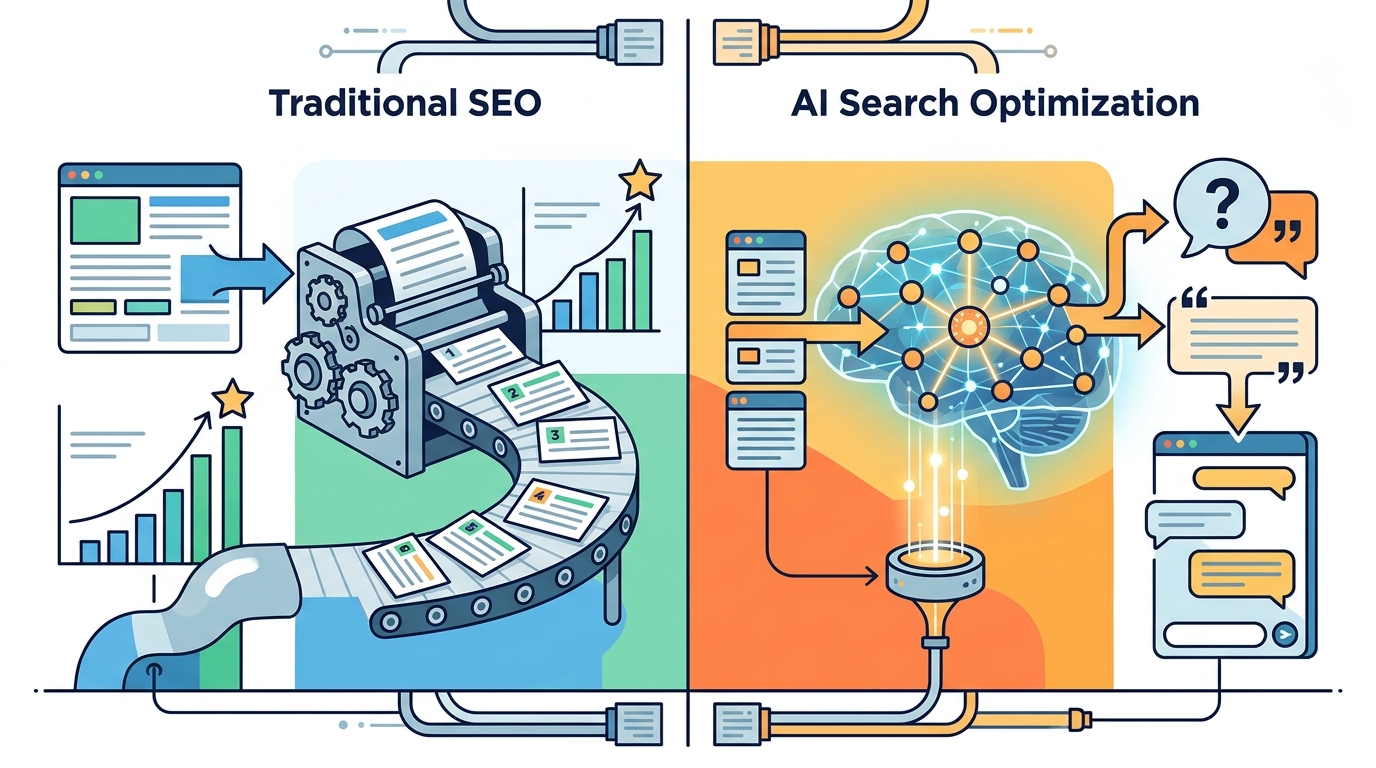
Traditional SEO is the process of optimizing websites to rank higher in organic search results on platforms like Google. It relies heavily on keyword matching, backlink authority, and technical site health. In contrast, AI search optimization is the practice of structuring your site and content so AI tools can find, understand, and cite your business. These tools, such as ChatGPT and Google AI Overviews, prioritize semantic clarity and direct answers over traditional keyword density. The shift means that visibility now depends on how well a machine can parse your value proposition, not just how many links point to your domain.
Technical Requirements and Implementation
Both approaches require a solid technical foundation, including fast load times, mobile responsiveness, and clean site architecture. However, AI search optimization places a higher premium on structured data and machine-readable formats. For example, implementing an llms.txt file provides AI systems with a simple guide to your public content, which is an optional but increasingly common practice. Traditional SEO also uses structured data, but primarily for rich snippets in standard search results. The implication is that modern web development must serve both human readers and machine parsers simultaneously, requiring a more nuanced approach to content organization.
Content Strategy and User Intent
Traditional SEO content strategy often focuses on capturing long-tail keywords and building topical authority through extensive blog networks. AI search optimization shifts the focus toward answering specific, high-intent questions with concise, authoritative responses. A business might write a 2,000-word article for traditional SEO, but for AI search, the same information might be distilled into a clear, 150-word summary that an AI tool can easily cite. This change implies that content teams must prioritize clarity and directness over length, ensuring that key facts are presented in a way that is easy for both humans and algorithms to extract.
Measuring Success and Business Impact
Traditional SEO success is typically measured by organic traffic, keyword rankings, and click-through rates. AI search optimization introduces new metrics, such as citation frequency in AI-generated responses and brand mention volume. For instance, a company might see a 143% increase in organic search sessions year over year through a strategy built for both Google and AI, as seen in recent case studies. The business impact of AI search optimization is often more direct, as users may trust AI recommendations and proceed to contact the business without visiting the website first. This suggests that businesses need to track inquiries and conversions from AI-driven traffic separately from traditional organic traffic to understand the full picture.
Integration and Future-Proofing
Many agencies now treat AI search optimization and traditional SEO as one unified strategy rather than two separate services. This integration approach ensures that a business remains visible across all discovery surfaces, from standard search results to AI chat interfaces. For example, a web design agency might build a new website with SEO in mind from day one, ensuring that the structure supports both traditional ranking and AI citation. The implication is that businesses should not choose one approach over the other, but rather adopt a holistic strategy that addresses the evolving landscape of search. This future-proofs their online presence against further shifts in how users discover information.
Key Takeaways
- Traditional SEO focuses on ranking in standard search results, while AI search optimization targets visibility in AI-generated responses.
- Both approaches require a strong technical foundation, but AI search places a higher premium on structured data and machine-readable formats.
- Content strategy for AI search prioritizes concise, direct answers over long-form keyword-heavy articles.
- Success metrics for AI search include citation frequency and brand mentions, in addition to traditional traffic and ranking data.
- Integrating both approaches into a single strategy ensures visibility across all modern discovery surfaces.
- Businesses should track AI-driven inquiries separately to understand the full impact of their optimization efforts.
Frequently Asked Questions
Is AI search optimization a replacement for traditional SEO?
No, AI search optimization is not a replacement for traditional SEO. It is an extension of the same foundational principles, adapted for new discovery surfaces. Most businesses benefit from a unified strategy that addresses both standard search results and AI-generated responses.
What is the main difference in content requirements?
The main difference is in clarity and structure. Traditional SEO content can be longer and more keyword-focused, while AI search optimization requires content that is easily parseable and directly answers specific questions.
How do I measure the success of AI search optimization?
You can measure success by tracking citation frequency in AI tools, brand mention volume, and inquiries that originate from AI-driven traffic. These metrics should be tracked alongside traditional SEO metrics like organic traffic and rankings.
Do I need to rebuild my website for AI search optimization?
Not necessarily. Many existing websites can be optimized for AI search by improving structured data, adding machine-readable formats, and refining content clarity. However, new websites should be built with both traditional SEO and AI search in mind from the start.
Which AI tools should I focus on for optimization?
Focus on the tools your target audience uses most. For many B2B and B2C businesses, this includes ChatGPT, Perplexity, and Google AI Overviews. Optimizing for these major platforms ensures broad visibility across the AI search landscape.
Conclusion
AI-powered search optimization and traditional SEO are not competing approaches but complementary strategies that together define modern digital visibility. By understanding the distinct mechanics of each, businesses can build a robust online presence that thrives in both standard search results and AI-generated recommendations. Mango Media helps service businesses across Ontario implement this unified strategy, ensuring they are found and chosen in the evolving search landscape.