

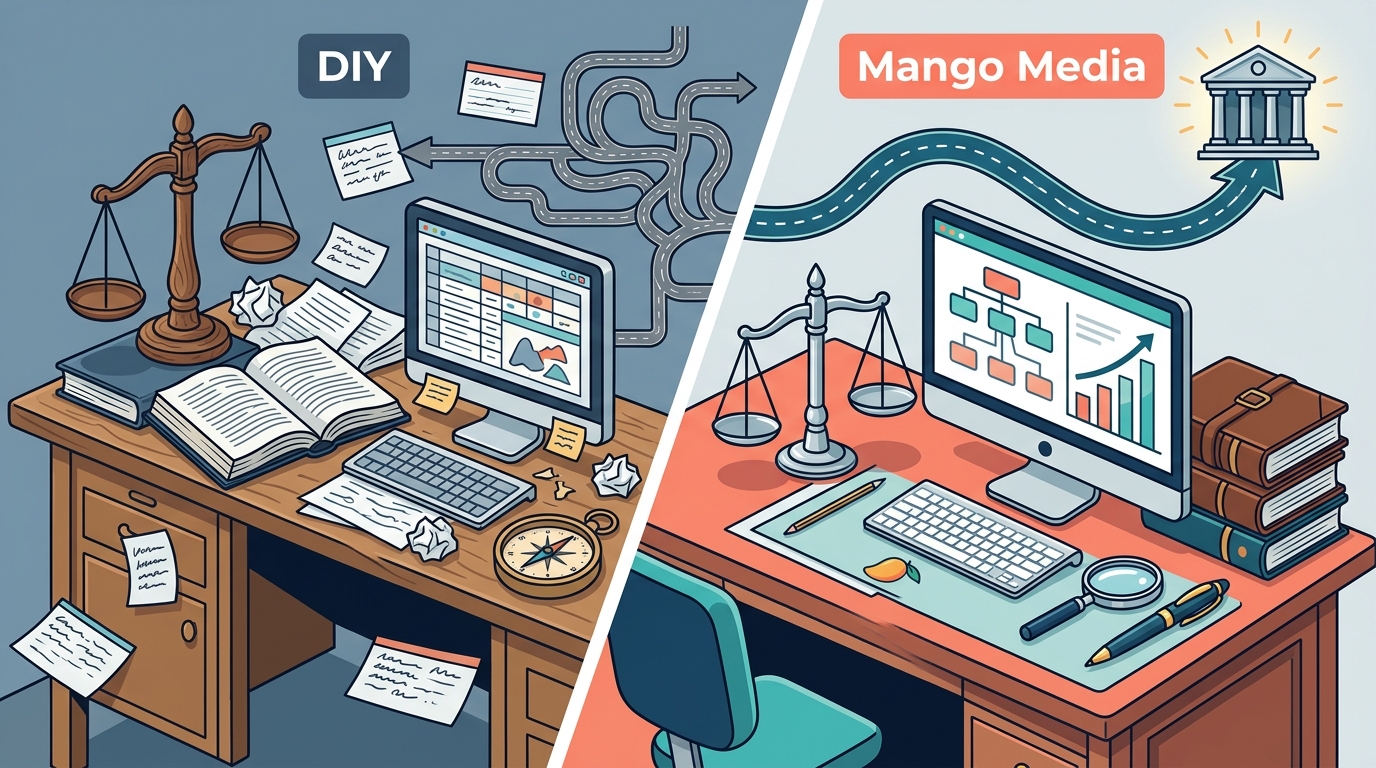
Hiring an SEO agency for law firms is often more effective than doing it yourself because legal marketing requires specialized knowledge of compliance, local search, and technical site architecture. While DIY efforts save initial costs, they frequently lack the strategic depth needed to compete in high-stakes legal markets. Mango Media, a Niagara-based agency, helps law firms navigate these complexities by combining technical SEO with clear, compliant content strategies that build trust with prospective clients.
The Complexity of Legal Search Intent
Legal search intent is distinct because users are often in a state of high stress or urgency. A person searching for a lawyer is not just looking for information; they are looking for a solution to a problem that affects their freedom, finances, or family. This emotional context means that generic blog posts rarely convert. Instead, search engines and users prioritize sites that demonstrate authority, empathy, and clear next steps. For a law firm, this requires a nuanced approach to content that balances educational value with professional credibility.
The evidence for this complexity lies in the structure of legal queries. Users often search for specific practice areas combined with location, such as "personal injury lawyer in Toronto" or "divorce attorney near me." These are high-intent keywords that require precise on-page optimization. If a firm attempts to manage this alone, they often miss the technical nuances of local SEO, such as optimizing Google Business Profiles and ensuring consistent citations across directories. This gap can lead to visibility in the wrong areas or a failure to rank for the most valuable terms.
The implication is that DIY efforts often stall at the technical level. Without a dedicated team to monitor algorithm updates and refine keyword targeting, a law firm may find itself invisible to the very clients it needs. An agency brings the experience of managing multiple legal clients, allowing them to apply proven frameworks that a solo practitioner or small in-house team might not have the bandwidth to develop.
Time Investment and Opportunity Cost
Lawyers are already overworked, and the time required to execute a comprehensive SEO strategy is significant. SEO is not a one-time task; it is an ongoing process of content creation, technical auditing, and performance analysis. For a partner or associate, spending hours each week on keyword research and link building is time taken away from billable client work. This opportunity cost is often underestimated when firms decide to handle their own marketing.
Consider the specific task of content production. A high-quality legal article requires not just legal expertise, but also an understanding of search engine optimization principles, such as proper heading structure, internal linking, and meta descriptions. A lawyer may be an expert in contract law, but they may not know how to structure that expertise for search engines. An agency handles this production pipeline, allowing legal professionals to focus on their core competency: practicing law. This division of labor ensures that the firm’s website is consistently updated with fresh, optimized content without draining the legal team’s resources.
The implication here is that DIY SEO often leads to inconsistent output. When marketing tasks compete with client deadlines, content updates may be sporadic or neglected. Search engines favor sites that demonstrate consistent activity and fresh content. By outsourcing, a law firm ensures a steady stream of optimized content that keeps the site active and relevant, which is a key factor in maintaining and improving search rankings over time.
Technical SEO and Site Architecture
Technical SEO is the foundation of any successful search strategy, and it is often the most challenging aspect for non-technical teams to manage. For law firms, this includes ensuring that the website is fast, mobile-friendly, and structured in a way that search engines can easily crawl and index. Legal websites often have complex structures with multiple practice areas, attorney profiles, and location pages. Managing this architecture requires a deep understanding of HTML, CSS, and search engine protocols.
A concrete example of this challenge is the management of internal links. Internal links help search engines understand the relationship between different pages on a site. For a law firm, this means linking from a general "Family Law" page to specific sub-pages like "Child Custody" and "Divorce Settlement." If these links are not structured correctly, search engines may not recognize the hierarchy of the site, leading to poor indexing. An agency can audit and optimize this structure, ensuring that each page is properly connected and that search engines can navigate the site efficiently. This level of technical detail is rarely a priority for legal teams, who are focused on the content itself rather than the underlying code.
The implication is that technical issues can silently undermine a firm’s visibility. A site may have excellent content, but if it is slow to load or poorly structured, it will not rank well. An agency provides the technical expertise to identify and fix these issues, ensuring that the firm’s content is accessible to both users and search engines. This technical foundation is critical for long-term success, as it supports all other SEO efforts, from content to local optimization.
Compliance and Ethical Marketing
Legal marketing is subject to strict ethical guidelines and regulations that vary by jurisdiction. These rules govern how lawyers can advertise, what claims they can make, and how they can interact with potential clients. Violating these rules can result in disciplinary action, fines, or damage to the firm’s reputation. For a law firm, this adds a layer of complexity to SEO that is not present in other industries. Content must be carefully reviewed to ensure it complies with local bar association rules and advertising standards.
An agency that specializes in legal SEO understands these compliance requirements. They know how to write content that is both optimized for search engines and compliant with ethical guidelines. This expertise is crucial for avoiding the risks associated with DIY marketing. A lawyer may be unaware of specific advertising restrictions, leading to content that could be considered misleading or overly promotional. An agency acts as a safeguard, ensuring that all marketing materials meet the necessary standards. This not only protects the firm from potential penalties but also builds trust with prospective clients who value ethical practice.
The implication is that compliance is a critical factor in the decision to hire an agency. While DIY efforts may seem cost-effective, the risk of non-compliance can be far more expensive in the long run. An agency provides a layer of expertise that ensures the firm’s marketing is both effective and ethical. This is particularly important in a competitive market where reputation is everything. By working with a specialized agency, a law firm can focus on its legal practice while confident that its marketing is handled with the necessary care and precision.
Measuring ROI and Long-Term Growth
One of the biggest challenges of DIY SEO is measuring return on investment. Without a clear framework for tracking performance, it is difficult to know which efforts are driving results. Search engines provide data, but interpreting that data requires experience. A law firm may see an increase in traffic, but without understanding the source of that traffic or the quality of the leads, it is hard to make informed decisions about future marketing spend. An agency brings a data-driven approach to SEO, using analytics tools to track key performance indicators such as rankings, traffic, and conversions.
A concrete example of this is the use of conversion tracking. An agency can set up tracking to measure how many website visitors contact the firm, book a consultation, or request a callback. This data allows the firm to see which pages and keywords are driving the most valuable leads. With this information, the firm can refine its strategy to focus on the areas that are delivering the best results. This level of insight is rarely available to firms managing their own SEO, as they may not have the tools or expertise to set up and interpret these metrics. The implication is that an agency provides a clear view of ROI, allowing the firm to make data-driven decisions that maximize the impact of its marketing budget.
Long-term growth is another key benefit of working with an agency. SEO is a long-term investment, and results take time to materialize. An agency provides the consistency and expertise needed to sustain growth over time. They monitor algorithm updates, adjust strategies as needed, and continuously optimize the site for better performance. This ongoing support ensures that the firm’s visibility continues to improve, even as the search landscape changes. For a law firm, this means a steady stream of qualified leads that can be converted into new clients. The implication is that an agency provides a partner in long-term growth, helping the firm build a sustainable marketing engine that delivers results year after year.
Key Takeaways
- Legal search intent is high-stakes and requires specialized content strategies that balance authority with empathy.
- DIY SEO often fails due to the time investment required and the technical complexity of legal websites.
- Technical SEO, including site architecture and internal linking, is critical for visibility and is best handled by experts.
- Compliance with ethical marketing guidelines is a major risk for DIY efforts and is a key strength of specialized agencies.
- Agencies provide data-driven insights and conversion tracking that help law firms measure ROI and refine their strategies.
- Long-term growth requires consistent, expert management of SEO efforts, which is difficult to sustain in-house.
- Outsourcing SEO allows legal professionals to focus on their core competency: practicing law.
Frequently Asked Questions
How long does it take to see results from SEO for a law firm?
SEO is a long-term strategy, and it typically takes 3 to 6 months to see significant improvements in rankings and traffic. The timeline can vary depending on the competitiveness of the market and the current state of the website. Consistency and quality are key factors in achieving results.
Can a small law firm afford an SEO agency?
Yes, many agencies offer scalable packages that fit the budget of small law firms. The cost of an agency is often offset by the time saved and the increased revenue from new clients. It is important to choose an agency that offers transparent pricing and clear reporting.
What is the biggest mistake law firms make with DIY SEO?
The biggest mistake is focusing on content without considering technical SEO and compliance. Many firms create great content but fail to optimize the site structure or ensure that their marketing meets ethical guidelines. This can lead to poor rankings and potential disciplinary action.
How does an agency handle legal compliance in SEO?
Agencies specializing in legal SEO have experience with bar association rules and advertising standards. They review all content to ensure it is compliant and ethical, providing a layer of protection that DIY efforts often lack. This expertise is crucial for avoiding risks associated with non-compliant marketing.
What metrics should a law firm track to measure SEO success?
Key metrics include organic traffic, keyword rankings, conversion rates, and lead quality. Tracking these metrics helps the firm understand which efforts are driving results and allows for data-driven decision-making. An agency can provide regular reports on these metrics to keep the firm informed.
Is it better to hire a generalist or a legal-specific SEO agency?
A legal-specific agency is generally better because they understand the unique challenges of legal marketing, including compliance and search intent. They have experience working with law firms and can provide tailored strategies that address the specific needs of the legal industry. This specialization often leads to better results than a generalist approach.
Conclusion
Hiring an SEO agency for law firms offers significant advantages over DIY efforts, including specialized expertise, technical proficiency, and compliance management. While DIY may seem cost-effective, the time investment and risks often outweigh the benefits. Mango Media provides law firms with a strategic partner that understands the complexities of legal marketing, ensuring that your firm is not just visible, but also trusted and compliant. By working with a specialized agency, you can focus on your practice while we handle the details of getting you found by the clients who need you most.